What is Ultherapy PRIME and how does it work?
Ultherapy PRIME is a lifting device that delivers focused ultrasound energy while showing the layers beneath the skin on real-time ultrasound imaging.
Understanding Lifting · Q9
Question: How does HIFU (ultrasound) lifting work?
HIFU (ultrasound) lifting is a non-invasive treatment that focuses ultrasound energy on a single point at a specific depth beneath the skin to create tiny thermal coagulation points (TCPs). This heat is described as contracting collagen in the SMAS (superficial musculoaponeurotic system) and deep dermis and stimulating new collagen production. Moderate pain during treatment and reactions such as redness, swelling and bruising have been reported, and their degree varies from person to person.
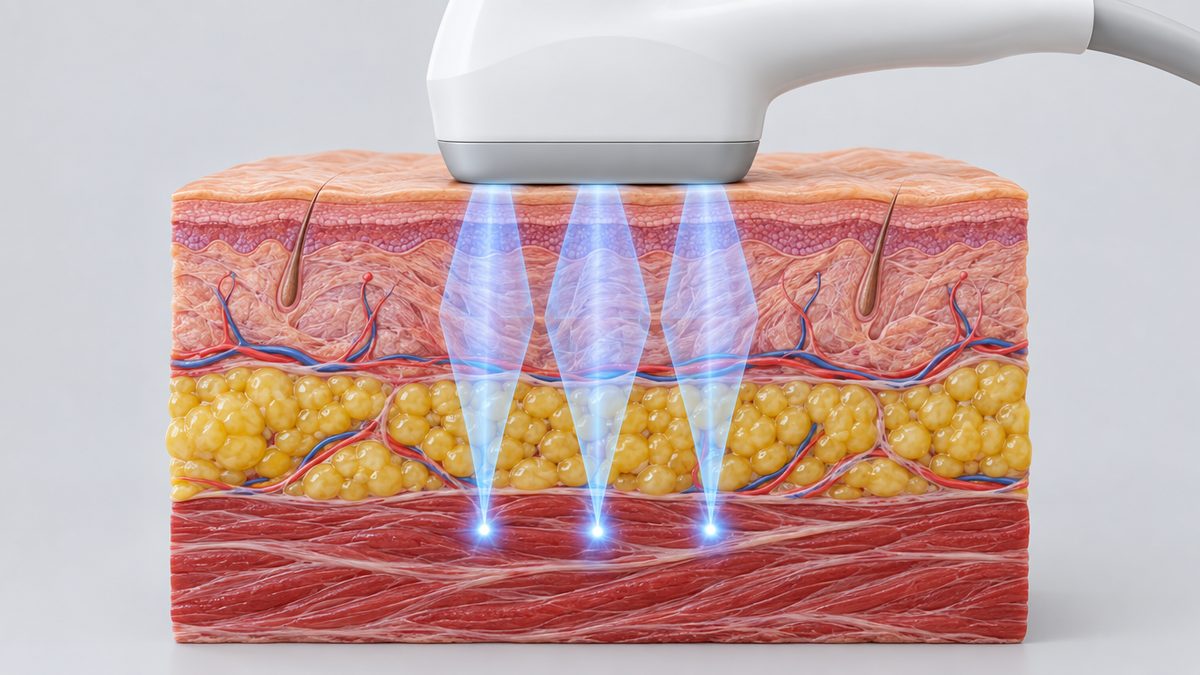
HIFU focuses ultrasound energy on a single point at a specific depth beneath the skin to create a tiny thermal coagulation point (TCP).
It works much like a magnifying glass concentrating sunlight on one spot, focusing ultrasound at a focal point, and the papillary dermis and epidermis between the coagulation points are described as unaffected. This is why it is classed as a non-invasive treatment that does not cut or peel the skin surface.
The manufacturer of Ulthera also explains that acoustic energy is absorbed and heats the tissue, creating individual coagulation points.
| Device | Focal depth |
|---|---|
| Ultherapy PRIME | 1.5 mm (10 MHz), 3.0 mm (7 MHz), 4.5 mm (4 MHz or 7 MHz) |
| Shurink Universe Face | 1.5, 2.0, 3.0, 4.5 mm |
| Shurink Universe Booster | 1.5, 3.0, 4.5 mm |
The temperature at the focal point is described as briefly exceeding 60°C, creating coagulation points smaller than 1 mm³ at depths of up to about 5 mm.
Early studies reported that applying focused ultrasound to human skin tissue could create localized thermal injury up to 4 mm deep in the dermis, and the injury was usually shaped like an inverted cone.
In actual devices, each cartridge (transducer) has a fixed focal depth, so the depth is changed during treatment according to the area and skin condition.
The heat of the thermal coagulation points is described as denaturing and contracting collagen fibers in the SMAS, platysma and deep dermis and stimulating new collagen production.
The SMAS is the superficial musculoaponeurotic system that covers the facial muscles, and HIFU is described as targeting down to this layer.
The manufacturer of Ulthera explains that some initial lifting may be felt, but the final result appears over 2 to 3 months as new collagen and elastin form. The degree and duration of results differ from person to person.
HIFU lifting is described as most suitable for mild to moderate sagging of the skin and soft tissue.
It is noted that older patients with severe sagging or distinct bands on the neck (platysmal bands) should consider surgery. It is important to understand the limits of non-surgical treatment and set expectations accordingly.
At CELITA Clinic, skin condition is checked with AI skin analysis and an ultrasound probe, and then the doctor explains in the consultation whether the treatment is suitable and what the recovery period is.
Moderate pain during HIFU treatment has been reported, and how much it is felt varies widely from person to person.
There are ways to reduce brief discomfort during treatment, and the medical team will advise according to the situation. CELITA Clinic does not routinely offer sedation, and applying numbing cream is considered depending on the type of treatment.
In studies, common adverse reactions were redness, edema, swelling, bruising and tenderness, and they were generally mild to moderate. Rarely, nerve symptoms such as temporary numbness or tingling, and burns due to improper technique, have also been reported.
HIFU focuses ultrasound energy on one point to create dot-shaped thermal coagulation, while radiofrequency uses electrical current rather than light. The difference in principle is not about which is superior but a criterion for choosing according to your goals and skin condition.
The manufacturer of Ulthera says daily activities can be resumed after treatment, but redness, swelling and tenderness vary from person to person. CELITA Clinic's general aftercare advice is to avoid alcohol, smoking, saunas and strenuous exercise for 1 week.
CELITA Clinic has Ultherapy PRIME and Shurink Universe as HIFU devices. Which device and depths to use is decided after analysis and consultation.
This article is general medical information, not a diagnosis or treatment. Results, recovery time and side effects vary with each person's skin, and whether a treatment suits you is decided after consultation with a doctor. If you notice unusual symptoms, contact the clinic that treated you right away.