What is the difference between HIFU lifting and RF lifting?
HIFU lifting focuses acoustic energy on a single point, while RF lifting delivers energy based on electrical current to the skin.
Comparing Treatments · Q41
Comparing Treatments · Q40
Question: What is the difference between Ultherapy and Thermage?
Ultherapy (Ultherapy PRIME) is a focused ultrasound (HIFU) device that concentrates ultrasound energy on a single point at a set depth beneath the skin to create thermal coagulation points, while Thermage FLX is a monopolar radiofrequency device that delivers radiofrequency (RF) energy to the skin. Because the type of energy and how it is delivered differ, the sensation during treatment, the timing of results described by the manufacturers and the pattern of side effects also differ. A small study comparing the two approaches reported no statistical difference, so rather than one being superior, the choice is made at consultation to suit your skin condition and goals.
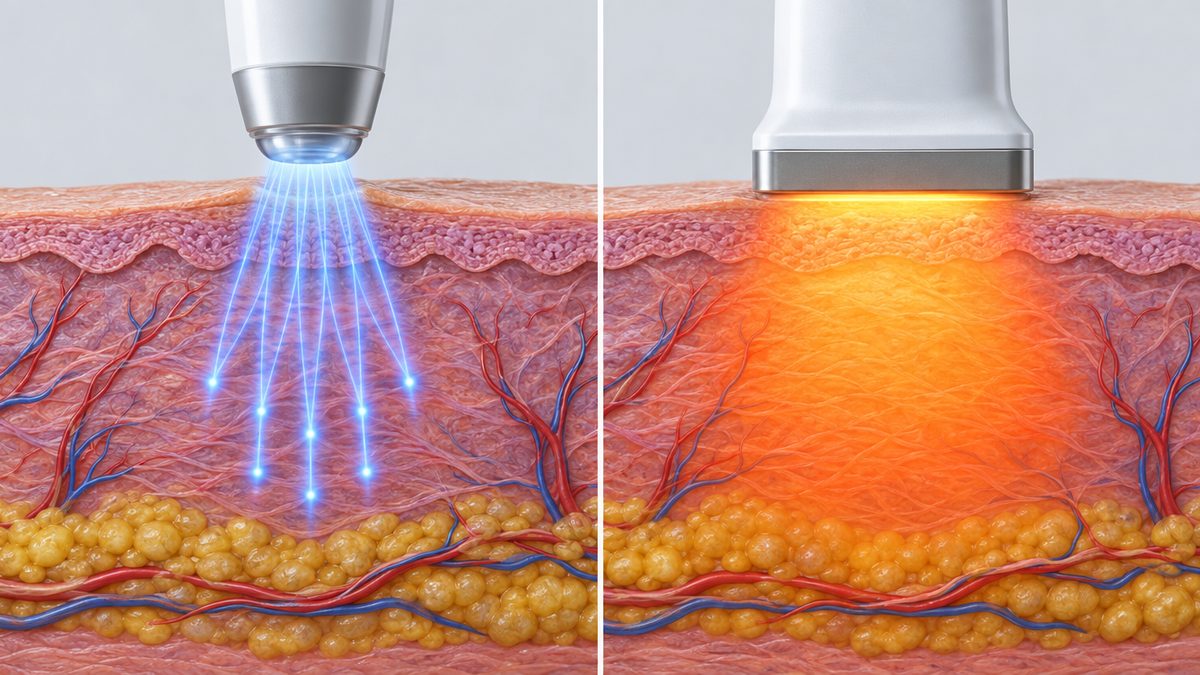
The basic difference is that Ultherapy uses ultrasound (HIFU) energy and Thermage uses radiofrequency (RF) energy.
Ultherapy PRIME concentrates ultrasound energy on a single point at a specific depth beneath the skin to create small thermal coagulation points. The manufacturer's instructions for use explain that as the acoustic energy is absorbed, it heats tissue to create discrete coagulation points, and this heat is known to denature and contract collagen in the SMAS (superficial musculoaponeurotic system) and deep dermis and stimulate new collagen production.
The Thermage FLX manufacturer explains that the handpiece delivers radiofrequency energy to the skin, with integrated cooling and vibration, and is designed to continually adjust energy delivery according to skin condition. Radiofrequency is a non-ablative technology that uses electrical current rather than light.
| Item | Ultherapy PRIME | Thermage FLX |
|---|---|---|
| Energy | Focused ultrasound (HIFU) | Monopolar radiofrequency (RF) |
| Delivery | Creates thermal coagulation points at set depths | Delivers RF to the skin, with integrated cooling and vibration |
| Treatment depth | 1.5, 3.0, 4.5 mm (by transducer) | No figure given by manufacturer |
| Imaging | DeepSEE real-time ultrasound imaging (up to 8 mm) | Not described by manufacturer |
| Timing of results (manufacturer) | Over 2-3 months | Over 2-6 months |
| Duration (manufacturer) | Face: up to a year or more | 1-2 years |
| Common reactions | Redness, swelling, tenderness, temporary nerve effects | Pain during treatment, redness, swelling |
| MFDS approval (Korea) | Import approval number 09-1024 (as of 2026) | Import approval number 18-245 (as of 2026) |
Ultherapy has a fixed focal depth for each transducer, while the Thermage manufacturer only states that energy is delivered to the skin and gives no depth figure.
The treatment focal depths of Ultherapy PRIME are 1.5 mm, 3.0 mm and 4.5 mm depending on the transducer. It received US FDA 510(k) clearance for using the DeepSEE transducer to view ultrasound images up to 8 mm beneath the skin to confirm transducer contact and the appropriate treatment depth.
The Thermage FLX manufacturer explains that you feel brief heat when the tip touches the skin, followed by a cooling sensation that protects the skin and reduces discomfort. The Ultherapy manufacturer states that treatment takes about 30-90 minutes depending on the area.
According to the manufacturers, improvement appears over 2-3 months with Ultherapy and over 2-6 months with Thermage.
The Ultherapy manufacturer explains that some initial lifting may be felt, but final results appear over 2-3 months as new collagen and elastin form, that facial results can last a year or more, and that results vary by individual. The Thermage manufacturer explains that some people feel immediate tightening and that results can last 1-2 years depending on skin condition and the aging process.
In a 6-month randomized study of 20 people treated with monopolar radiofrequency on one side of the face and microfocused ultrasound (MFU-V) on the other, both approaches improved facial and neck laxity, with no statistical difference in laxity scores or adverse reactions. Manufacturer figures and study results are reference information and do not promise individual results.
Redness and swelling are common with both devices, and burns or temporary numbness and tingling can rarely occur.
According to the Ultherapy instructions for use, in face and neck clinical studies, redness usually resolved within a few hours, swelling usually within 3-72 hours and tenderness to touch within 2 days to 2 weeks, while temporary nerve effects such as numbness and tingling usually resolved within 2-6 weeks. It states that burns and scarring can occur with improper technique.
The Thermage manufacturer notes that mild to moderate pain during treatment is common, and that redness after treatment usually resolves within 24 hours and swelling usually within 5 days, though it can last up to several weeks. Burns, blisters or scabs, subcutaneous nodules mainly in the neck, and numbness or tingling lasting up to several weeks have rarely been reported.
The device is decided at consultation after checking the degree of sagging, the areas you want treated and any contraindications.
CELITA Clinic has both Ultherapy PRIME and Thermage FLX, and checks skin condition before treatment with EVE V MUSE AI skin analysis and the Sono Finder ultrasound probe. Since both are non-surgical treatments, the consultation also explains that the changes you can expect are limited when sagging is severe.
If you have an implanted device such as a pacemaker or defibrillator, neither device can be used, so be sure to mention it. Pregnancy or breastfeeding, autoimmune disease, diabetes and epilepsy are also groups that have not been studied or evaluated for either device, so these are checked at consultation.
Pain levels differ from person to person, so it cannot be said that one hurts less. Moderate pain has been reported in focused ultrasound studies, and the Thermage manufacturer also notes that mild to moderate pain during treatment is common. CELITA Clinic does not provide sedation as standard, and numbing cream is considered depending on the type of treatment.
According to the FDA 510(k) K233996 summary, the PRIME console has a modernized exterior design and screen, and its hardware was updated to meet the latest electromedical standards. It states that the ultrasound signal energy and treatment guidelines are the same as the previous device.
The combination and order of treatments differ for each procedure, so the plan is reviewed during consultation. When both devices are being considered, how to proceed is decided based on your skin condition and schedule.
This article is general medical information, not a diagnosis or treatment. Results, recovery time and side effects vary with each person's skin, and whether a treatment suits you is decided after consultation with a doctor. If you notice unusual symptoms, contact the clinic that treated you right away.